
Topic ID No.: 2026-G18
Title of research topic:
Integrated Data Science for Agriculture and Food Security - Postdoctoral Researcher and PhD Student Positions
Description:
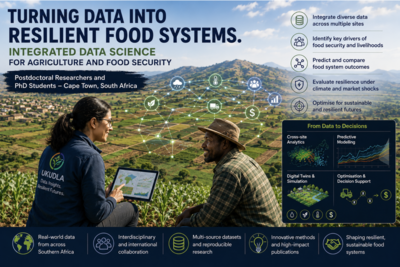
Develop and apply computational methods to integrate agricultural, environmental, socio-economic and value chain data into unified representations of food systems. Identify the key drivers of food security, livelihoods and resilience. Develop predictive and systems-level models linking environmental and socio-economic processes to food system performance under current and future climatic conditions.
Research Project:
UKUDLA is an African–German research centre on sustainable and resilient food systems that conducts transdisciplinary, data-driven research across multiple sites in Southern Africa, combining field experiments, observational studies and stakeholder-driven living laboratories. The project develops data-driven methods to integrate heterogeneous agricultural, environmental, socio-economic and value chain data across the UKUDLA research sites into a unified and comparable representation of food systems. The integrated representation enables cross-site analysis. The research identifies key variables and interactions that determine di!erences in outcomes, in particular food security, livelihoods and sustainability. It formulates optimisation approaches based on these structures. It extends these approaches to explicitly account for resilience. The goal is robust system behaviour under stress conditions such as climate variability, market shocks and resource constraints. Methodologically, the project combines statistical learning with causal and probabilistic modelling and system-level simulation, including digital twins and data-driven optimisation. The work combines data integration, statistical learning and systems modelling. It leverages applied data science to support evidence-based decision making for agriculture and food security in Southern Africa.
Job description:
You will:
- Develop methods to integrate heterogeneous agricultural, environmental, socio-economic and value chain data from UKUDLA sites into a unified and comparable food system representation.
- Identify key variables and interactions that determine di!erences in food system outcomes across sites, in particular food security, livelihoods and sustainability.
- Develop predictive and systems-level models to explain, compare and forecast food system behaviour under varying environmental and socio-economic conditions.
- Integrate climate model projections to evaluate future food system performance, identify vulnerabilities and quantify resilience under expected climatic change.
- Formulate data-driven optimisation approaches based on these structures.
- Extend these approaches to explicitly incorporate resilience under stress conditions such as climate variability, market shocks and resource constraints.
- Implement and evaluate the methods using cross-site data and real-world use cases.
Applicant profile:
We are looking for candidates with:
- Strong background in applied data science and quantitative modelling.
- Experience in data engineering, heterogeneous data integration, statistical learning and machine learning.
- Experience in agronomy and quantitative agricultural data analysis is desirable.
- Familiarity with causal or probabilistic modelling, simulation methods, robustness analysis and geospatial data
is advantageous. - Proficiency in Python and/or R, scripting and reproducible workflows expected.
- Ability to analyse complex systems, work independently and communicate results e!ectively.
- Experience in scientific visualisation is desirable.
- Commitment to FAIR data principles, reproducible research, high-quality documentation and scientific
predictability. - Strong interest in publication-oriented research and scientific writing.
- Excellent English skills.
- Ability to work in interdisciplinary, international teams.
We offer:
- A fully funded PhD/Postdoctoral position within the African–German UKUDLA Centre of Excellence.
- An international and interdisciplinary research environment.
- Collaboration with researchers from South Africa, Germany and partner institutions across Africa.
- Access to unique agricultural, environmental and socio-economic datasets from multiple research sites.
- Opportunities to develop novel computational methods and publish in high-impact journals.
- Possibility to contribute to international grant proposals and collaborative research projects.
Contact person:
Prof. Dr. Asis Hallab