
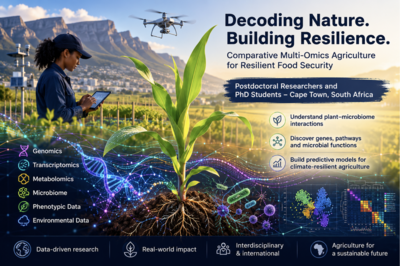
Topic ID No.: 2026-G19
Title of research topic:
Comparative Multi-Omics Agriculture for Resilient Food Security - Postdoctoral Researcher and PhD Student Positions
Description:
Develop and apply computational methods to integrate multi-omics, environmental and phenotypic data. Identify molecular and microbial mechanisms underlying crop productivity, stress tolerance and resilience. Develop predictive models linking biological processes to agricultural performance under current and future climatic conditions.
Research Project:
UKUDLA is an African–German research centre on sustainable and resilient food systems that conducts transdisciplinary, data-driven research across multiple sites in Southern Africa, combining field experiments, observational studies and stakeholder-driven living laboratories. This project develops methods to integrate genomic, transcriptomic, metabolomic, microbiome, phenotypic and environmental data to identify biological mechanisms underlying agricultural productivity and resilience. The project builds on extensive phenotyping, climate and genomic data generated within UKUDLA and extends these through targeted proof-of-concept experiments and integration of publicly available multi-omics datasets. A particular focus is the identification of beneficial plant-associated microbial communities and molecular functions that enhance resilience to climatic and biotic stress. Methodologically, the project combines comparative genomics, comparative transcriptomics, systems biology, statistical learning and predictive modelling. It further develops novel approaches for comparative analysis of gene expression and biological responses across genes, species and environmental conditions. The long-term goal is to identify molecular mechanisms, predictive biomarkers and beneficial microbial communities that can support resilient agricultural production under future climatic conditions.
Job description:
You will:
- Apply and develop methods to integrate phenotypic, climatic, environmental, genomic, transcriptomic, micro-biome and other omics data into unified representations of crop and agricultural system responses.
- Identify genes, pathways, microbial taxa and biological functions associated with productivity, stress tolerance and resilience.
- Develop predictive and systems-level models linking molecular and microbial profiles to agronomic performance under current and projected climatic conditions.
- Design and evaluate proof-of-concept experiments for integrated plant–microbiome analyses.
- Develop and assess novel geometric approaches for comparative analysis of gene expression and biological responses across genes, species and environmental conditions.
- Validate methods using public and UKUDLA datasets.
Applicant profile:
We are looking for candidates with:
- Strong background in bioinformatics, computational biology, data science, high performance computing or a related quantitative discipline.
- Familiarity with statistical learning, predictive modelling and (biological) data integration expected.
- Proficiency in Python and R, scripting and reproducible workflows required.
- Experience with genomics, transcriptomics, microbiome analysis or systems biology is advantageous.
- Ability to analyse complex (biological) systems, work independently and communicate results e!ectively.
- Experience in high performance computing programming with one high performance language like Fortran, C/C++, Julia, or Rust is advantageous.
- Commitment to FAIR data principles, reproducible research, high-quality documentation and scientific predictability.
- Strong interest in publication-oriented research and scientific writing.
- Excellent English skills.
- Ability to work in interdisciplinary, international teams.
We offer:
- A fully funded PhD/Postdoctoral position within the African–German UKUDLA Centre of Excellence.
- An international and interdisciplinary research environment.
- Collaboration with researchers from South Africa, Germany and partner institutions across Africa.
- Access to unique field, genomic and multi-omics datasets.
- Opportunities to develop novel computational methods and publish in high-impact journals.
- Possibility to contribute to international grant proposals and collaborative research projects.
Contact person:
Prof. Dr. Asis Hallab